WeatherOptics MCP Beta Setup
Wire the WeatherOptics MCP server into ChatGPT or Claude so you can ask natural-language questions about weather risk, forecasts, routes, and severe weather for your asset locations — including inline maps.
Before you start
You need:
- A ChatGPT or Claude account — any plan works, including Free.
- Your WeatherOptics login (the email + password you use for the portal). You don't need an API key — you'll sign in with WeatherOptics during setup and choose exactly which capabilities to share.
Install from the ChatGPT plugin directory Recommended
1 Find WeatherOptics
In ChatGPT, click Plugins in the left sidebar (or go to
chatgpt.com/plugins),
search for WeatherOptics, and open it.
Or go straight to the WeatherOptics listing.
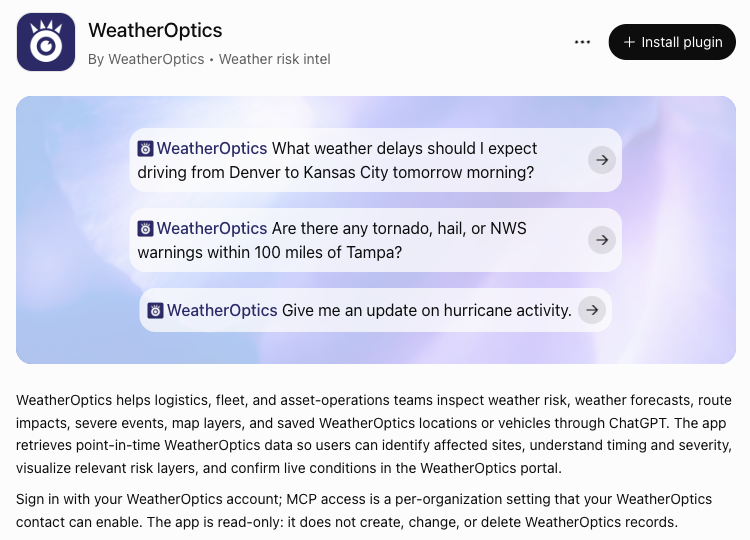
2 Install and connect
Click Install plugin, then Connect if ChatGPT asks.
3 Sign in with WeatherOptics
A WeatherOptics sign-in page opens: enter your WeatherOptics email and password and click Log in & connect. Then choose what ChatGPT may access: weather & risk data, route planning, and/or your saved assets. You can grant everything or just a subset; a tool you haven't granted replies with which permission it needs instead of failing silently. Click Connect.
To change what's shared later, open Settings → Plugins → WeatherOptics, disconnect the account and connect again; the permission picker runs again.
4 Test it in a new chat
Open a new chat and ask:
Using WeatherOptics, what weather delays should I expect driving from Denver to Kansas City tomorrow morning?Other ways to connect: add by URL (developer mode)
Use this for a WeatherOptics staging server, or if your workspace can't install the plugin from the directory.
1 Enable Developer Mode
Open ChatGPT → Settings → Plugins → Advanced. Turn on Developer mode.

ChatGPT will warn you this is elevated risk — that's expected. Confirm to enable.
2 Create the plugin
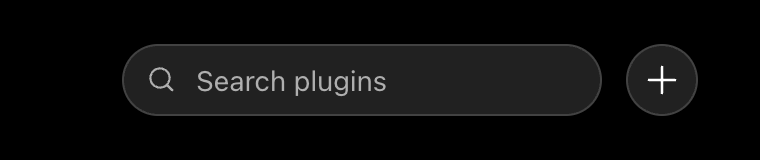
Open the Browse Plugins
page (chatgpt.com/plugins) and click the plus
(+) button at the top right, next to the plugin search
bar.
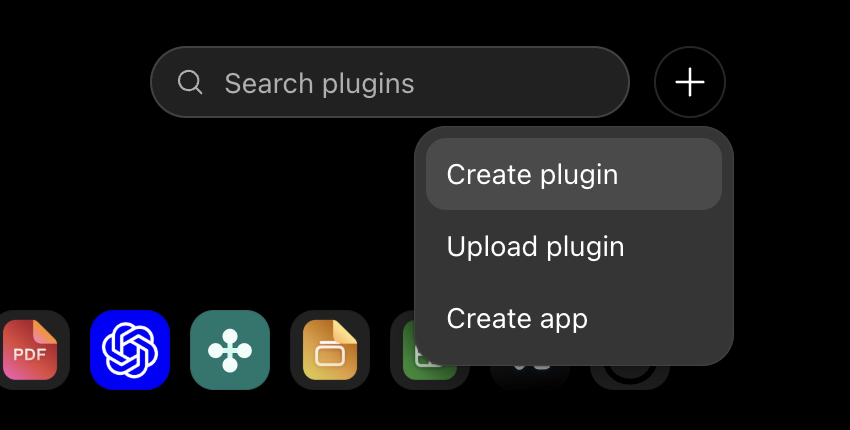
From the menu, choose Create app (not "Create plugin" or "Upload plugin").
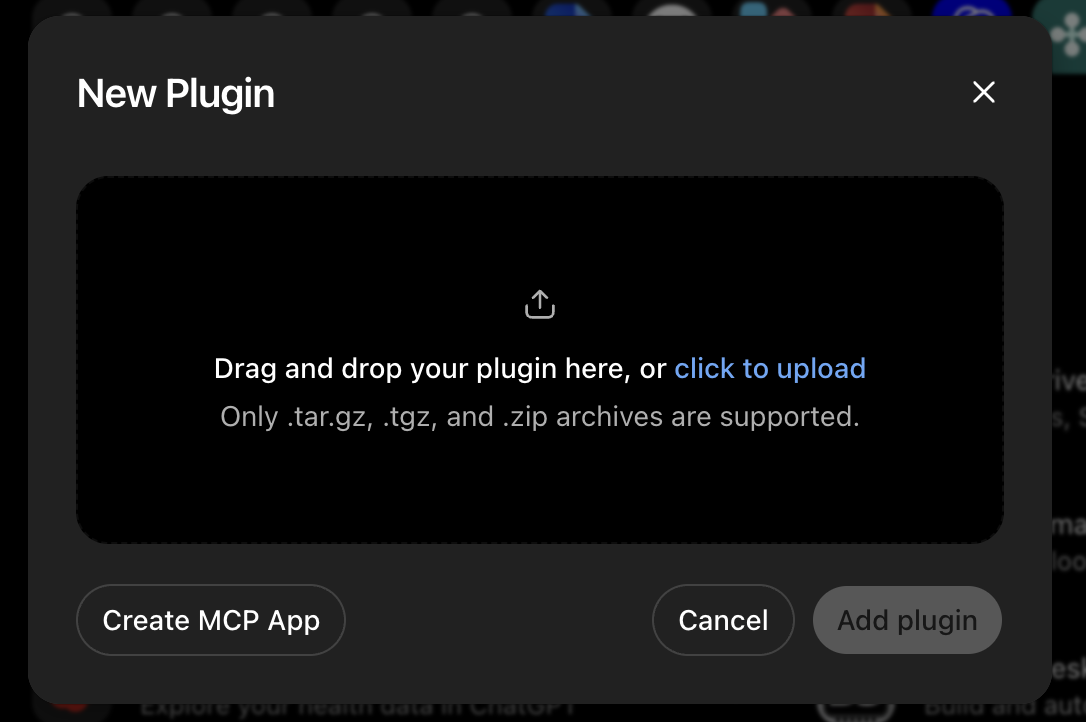
A New Plugin dialog opens with an area for uploading a plugin archive. Skip that and click Create MCP App at the bottom left.
Fill in the form like this:
- Name
- WeatherOptics MCP
- Description
- optional — e.g. "7-day weather risk for asset locations"
- Connection
- Server URL
- Server URL
- https://mcp.weatheroptics.co/mcp
- Authentication
- OAuth
- Risk checkbox
- Check "I understand and want to continue"
https://mcp.weatheroptics.co/mcpClick Create.
3 Connect your WeatherOptics account
Click Connect on the plugin. A WeatherOptics sign-in page opens: enter your login email + password, then choose which capabilities to share with ChatGPT — weather & risk data, route planning, and/or your saved assets. You can grant everything or just a subset.
Once connected, all WeatherOptics tools appear under Actions. A tool whose permission you didn't grant doesn't fail silently — it replies with a short explanation of which permission it needs. What each tool does is documented on the tools reference page. To change what's shared later, disconnect and reconnect the plugin — the permission picker runs again. Permissions your WeatherOptics administrator changes apply within about a minute, no reconnect needed.
4 Test it in a new chat
Open a new chat, attach an asset CSV (or just name a place), and ask:
Using WeatherOptics, which of my attached warehouses are at risk over the next 7 days?Maps render directly inline in the chat — try:
Using WeatherOptics, show me an interactive road-risk map around Chicago.Getting updates
If you added WeatherOptics by URL, refresh it whenever the WeatherOptics team ships a server update so ChatGPT picks it up: Settings → Plugins → the WeatherOptics plugin → scroll down past the tool listings to the "Information" section (the one showing "Connected on" and the server URL) → click Refresh at the top right of that section.
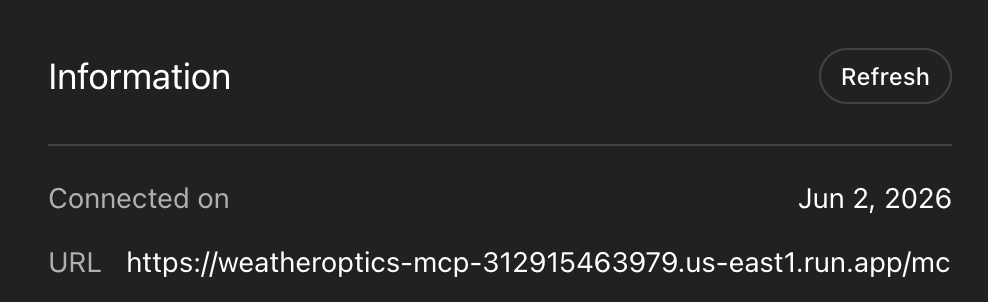
This matters especially for the inline map: ChatGPT caches the map widget template the first time it fetches it and reuses it across chats, so widget changes do not appear until you do this refresh.
Install from the Claude directory Recommended
1 Find WeatherOptics
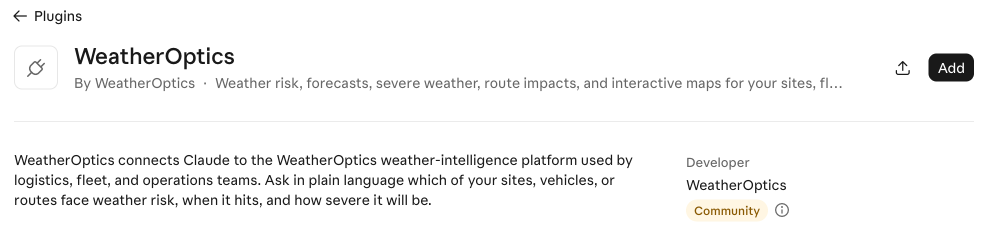
In Claude, click Plugins in the left sidebar, type WeatherOptics in the search box, and click the result.
Or go straight to the listing: claude.ai/directory/weatheroptics.

2 Click Add
Click Add at the top right of the WeatherOptics page. The WeatherOptics sign-in opens straight away. (With the older Customize page, the button is Connect.)
3 Sign in with WeatherOptics
A WeatherOptics sign-in page opens: enter your WeatherOptics email and password and click Log in & connect.
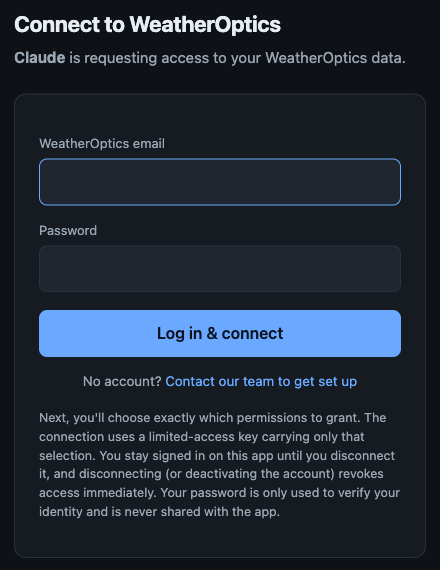
Then choose what Claude may access: weather & risk data, route planning, and/or your saved assets. You can grant everything or just a subset; every tool stays listed, and one you haven't granted replies with which permission it needs instead of failing silently. Click Connect. Claude shows Connected to WeatherOptics.
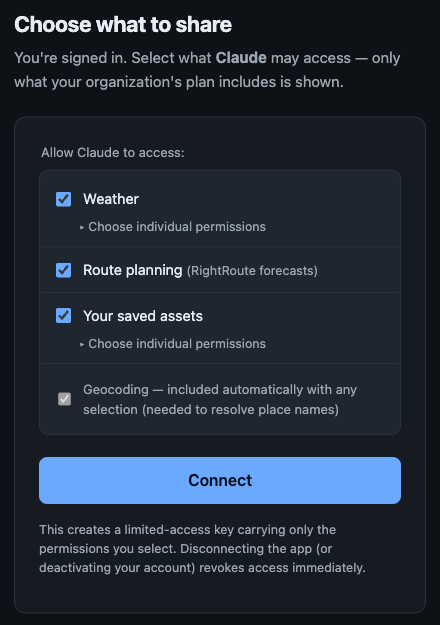
To change what's shared later, open WeatherOptics from Plugins, click the three-dots (⋮) menu at the top right, then Disconnect, and connect again; the permission picker runs again.
4 Let the tools run without asking
Open WeatherOptics from Plugins and click the Permissions tab. The tools are listed under Tool permissions, all set to Needs approval, which makes Claude ask before every WeatherOptics lookup. Every WeatherOptics tool only reads data, so set both group dropdowns, Interactive tools and Read-only tools, to Always allow.
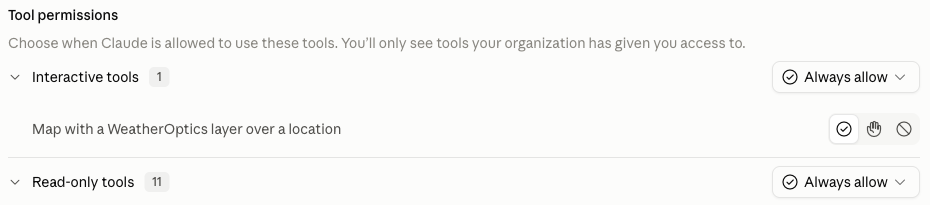
Optional: if you skip this, click Always allow on each tool the first time Claude asks to use it.
5 Test it in a new chat
Open a new chat, attach an asset CSV (or just name a place), and ask:
Using WeatherOptics, which of my attached warehouses are at risk over the next 7 days?Other ways to connect: add by URL
Use this for a WeatherOptics staging server, or if your organization doesn't use the directory.
1 Open Plugins → Add → Add custom connector
In Claude, click Plugins in the left sidebar, then Add at the top right, then Add custom connector.
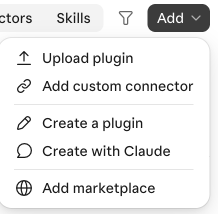
2 Enter the name and URL
Fill in the first screen, then click Continue:
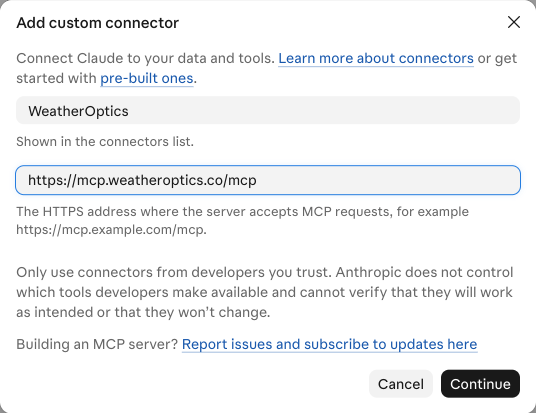
- Name
- WeatherOptics
- MCP server URL
- https://mcp.weatheroptics.co/mcp
https://mcp.weatheroptics.co/mcp3 Choose Sign in now, then click Add
Under Authentication, Claude pre-selects No sign-in and marks it Detected. Change it to Sign in now. (WeatherOptics lets Claude read the tool list before you sign in, which is what Claude's check picks up. Your data always needs your WeatherOptics sign-in.)
Leave everything else as it is: OAuth client, which appears once you pick Sign in now, stays on Use Claude's published identity (marked Recommended), and Request headers stays empty. Click Add at the bottom of the dialog.
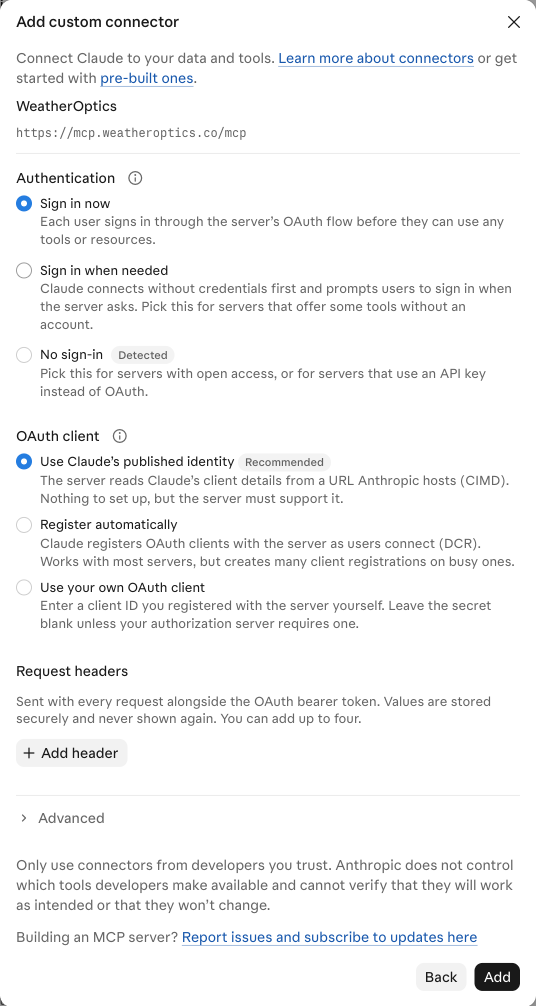
4 Connect your WeatherOptics account
Claude opens the new connector's page with a Connect button. Click it, then sign in and choose what to share exactly as in step 3 above, and set the tool permissions as in step 4 above.
Getting updates
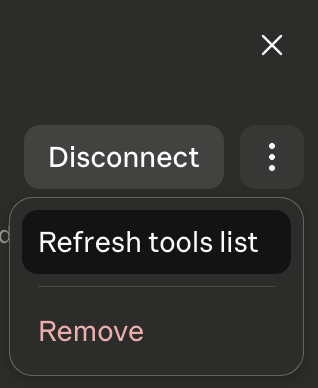
Whenever the WeatherOptics team ships a server update: Plugins → click WeatherOptics → the three-dots (⋮) menu at the top right → Refresh tools list.
Claude Code
1 Add the WeatherOptics server
In your terminal, run:
claude mcp add --transport http weatheroptics https://mcp.weatheroptics.co/mcp
This adds it to the current project only. To use it in every project,
add --scope user:
claude mcp add --transport http --scope user weatheroptics https://mcp.weatheroptics.co/mcp2 Sign in right away
In Claude Code, run /mcp, select weatheroptics,
and choose Authenticate (or Re-authenticate).
Your browser opens the WeatherOptics sign-in page: sign in, choose what
Claude Code may access, and click Connect. When the
browser says Authentication successful, return to Claude Code.
/mcp already shows
Auth: authenticated. Claude Code can list the WeatherOptics
tools before you sign in, so it shows that status until the first tool
call, which then fails with "needs you to sign in again".
You can also sign in from your shell with
claude mcp login weatheroptics, and sign out with
claude mcp logout weatheroptics.
3 Test it
Ask Claude Code something like:
Using WeatherOptics, what's the road risk around Chicago over the next 3 days?